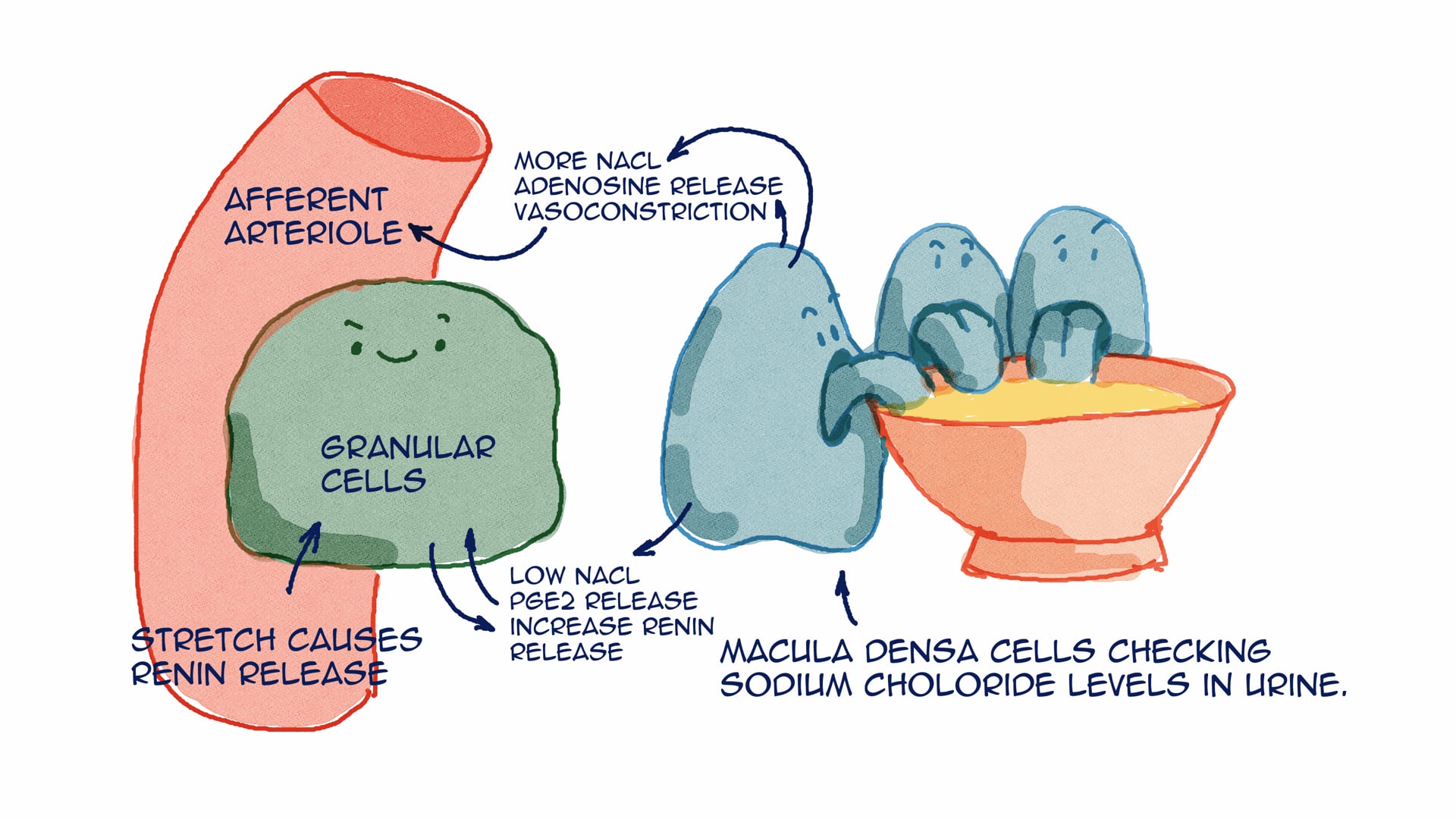
To understand how ACE inhibitors and ARBs work, we must first ground ourselves in the fundamental mechanisms of the Renin-Angiotensin-Aldosterone System (RAAS). In this lecture, we’ll focus entirely on how this hormonal system regulates blood pressure, fluid balance, and vascular resistance. We’ll explore the physiological triggers for its activation, the sequence of molecular events, and how chronic activation contributes to disease. Once we’ve established these foundational concepts, we’ll be well-positioned to discuss the pharmacology of drugs that target RAAS in the next session.
Learning Objectives:
- Describe the physiological role of the RAAS pathway in maintaining circulatory homeostasis.
- Identify the key stimuli for RAAS activation (e.g., hypotension, hypovolemia, sympathetic input).
- Outline the sequence of events in the RAAS cascade—from renin secretion to aldosterone action.
- Explain the effects of angiotensin II on vascular smooth muscle, the adrenal cortex, and CNS regulation of thirst and ADH.
- Discuss early pathological consequences of sustained RAAS activation, such as vasoconstriction and sodium retention.
- Differentiate between short-term adaptive roles of RAAS and long-term maladaptive consequences, preparing for next lecture’s focus on pharmacological modulation..
- Describe the physiological role of the RAAS pathway in maintaining circulatory homeostasis.
- Identify the key stimuli for RAAS activation (e.g., hypotension, hypovolemia, sympathetic input).
- Outline the sequence of events in the RAAS cascade—from renin secretion to aldosterone action.
- Explain the effects of angiotensin II on vascular smooth muscle, the adrenal cortex, and CNS regulation of thirst and ADH.
- Discuss early pathological consequences of sustained RAAS activation, such as vasoconstriction and sodium retention.
- Differentiate between short-term adaptive roles of RAAS and long-term maladaptive consequences, preparing for next lecture’s focus on pharmacological modulation..







Write A New Comment
2 Comments
bobchanel@*.com
Jun 10 2026, 1:20 am
HI Dr Bean. Thank you for the awesome video. It's so densely packed with information that I'll probably come back to this several times to review it before moving on.
kakavand@*.com
May 25 2025, 5:47 pm
Excellent explanation.